Home
Download Brochures
What's New!
Above Ground Tanks
Below Ground Cisterns
Septic Tanks
Accessories
Warranty
FAQ
Quick Reference
Other Products
|
| |
Frequently Asked Questions
About
CAN THE TANKS BE BURIED?
 | Tanks are manufactured specifically for either above
ground
or below ground use. |
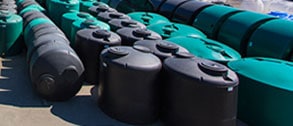
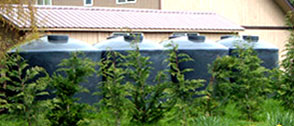
 | Above ground tanks have smooth sides and are for
ground level mounting only. They can however, be dropped into the ground to a depth of 25% of the
tank height. |
 | Underground tanks are designated as ‚cisterns™
and can be buried completely with up to two
feet of dirt cover unless otherwise noted.
(Refer to burying instructions.) Underground tanks are heavily ribbed or are ball shaped to resist ground pressure. |
WILL A HIGH WATER TABLE BE A PROBLEM?
 | If the water table is likely to rise a foot or more above
the
base level of a buried tank, the tank must be anchored down against possible
floating up when the tank is drained. (See
suggested anchoring details) Dirt cover and
water in the tank will of course help keep the tank in
place. |
 | Consult dealer or factory for high water table
installations. |
WHAT BASE IS REQUIRED?
 | A firm, level base that is continuous under the entire
tank
is required. |
 | Base can be sand, fine gravel, clean dirt, cement or properly supported and closely placed
planks. |
 | Pebbles larger that half inch should be removed.
|
CAN A PLATFORM BE USED?
 | Yes, however the tank bottom must be continuously
supported,
e.g. with two layers of 3/4 inch plywood nailed
to a suitable support structure. In the interest of
safety, an engineer should be consulted. NOTE - Weight
of water is 8.33 pounds per US gallon or 10 pounds
per Canadian gallon. |
WHAT ABOUT ALGAE GROWTH?
 | Algae growth is promoted by light penetration into
the
tank. Growth can be reduced by locating the tank away
from sunlight and choosing a darker tank colour and
by disinfection. |
HOW HEAVY ARE THE TANKS?
 | For a rough guide, the weight of above ground tanks
is
obtained by taking the gallon size and dividing by five.
E.g., a 1000 gallon tank will weight approximately 200
lb. |
 | For underground tanks, take the gallon size and
divide by three. |
ARE THEY EASY TO HANDLE?
 | All tanks can be moved by pick-up truck. |
 | Polyethylene is a very resilient material and damage is unlikely to occur
during careful handling and transportation. |
 | Extra care must be taken in extreme cold weather. |
CAN I PUT PRESSURE ON THE TANK?
 | NO! Polyethylene tanks must be open to atmosphere
or
vented at all times. They can be used to provide a head
of water by mounting at a higher elevation but cannot
be subjected to any external pressure source. |
WHAT HAPPENS IF MY TANK FREEZES?
 | It is unlikely that a partially full tank will split. The walls
will
only swell under the pressure of ice. A tank will start
to freeze only during extended periods of cold weather. |
 | Piping should be protected or drained during
freezing weather because the smaller volume
of water in the piping will freeze more
easily and may split the pipe. |
 | If freezing is a concern, the tank can be
insulated with a waterproof insulation or
put in an insulated shed. |
 | An underground tank offers the best protection
from freezing. It will also keep the water
cool in summer. |
WHAT FITTINGS COME WITH THE TANK?
 | Above ground water tanks are fitted with a 2 inch
female
threaded pipe connection at the bottom and a 16 inch
access cap at the top. Access caps have breather
valves that let air in and out as the water level changes.
Your local plumber or plumbing store can help you with
making the proper connections. |
 | Additional connections for inlet pipes are added
separately
to customer requirements. |
 | For approximate pipe sizing refer to Pipe Sizing Chart. |
WHAT ABOUT COLLECTING RAINWATER?
 | Collecting rainwater is an excellent way to bridge
periods
of short water supply. |
 | A filter basket should be used to screen out leaves,
twigs and debris coming from the eaves troughs. |
 | Water for drinking, cooking and dish washing must of
course be boiled or disinfected. |
 | Clean rainwater can be used for large volume uses
such
as toilet flushes, laundry, showers, washing cares and
watering the garden. (When throwing water around during
those dry spells be sure to let your neighbours know
where it is coming from!) |
DOES SUNLIGHT AFFECT THE TANKS?
 | Over time, exposure to sunlight causes the plastic to
harden which makes it more prone to cracking if the tank
receives a heavy blow. |
 | All Premier Plastics tanks are impregnated with an
ultraviolet
inhibitor that slows this hardening effect. |
HOW LONG IS THE WARRANTY?
 | All above ground tanks carry an eight year warranty,
however, you can expect many more years of service. |
 | All underground water tanks and septic tanks carry
a
hundred year warranty. Polyethylene will virtually last forever
underground. |
ARE THE TANKS SAFE FOR DRINKING WATER?
 | YES - tanks are manufactured from food grade polyethylene
and meet specifications contained in FDA regulations
21 CFR 177.1520(c)3.1 and NSF Standard 51. |
 | Maintaining the quality of water in the tank is of course
your responsibility. Information on water quality can be
obtained from water supply companies, well drillers or
local public health departments. |
WILL I NOTICE A DIFFERENCE IN TASTE?
 | To keep the water fresh, your piping should be
connected
so that incoming water is always flushing through the
tank. |
 | Water that has been sitting in any type of vented
container
for a period of time will develop a ‚flat™ taste. This
is because air in the water has been lost. This can
partly overcome by half filling a closed vessel and shaking
it vigorously to put the air back in. (Refer to item
on drinking water.) |
HOW WILL A STORAGE TANK HELP A SLOW PRODUCING
WELL?
 | Many people are experiencing reduced flow rate from
their
wells. Well pumps are usually sized to provide water
on demand, i.e. If your bathtub fills at 5 gallons a
minute then the well must produce water at 5 gallons a
minute for the time the bath is running. |
 | A storage tank allows short periods of high demand to
come from the tank and not directly form the well. |
 | A family using 400 gallons per day would need their
well
to produce no more than 400 gallons over 24 hours if a
storage tank is used. On average, a well needs only to
produce half a gallon a minute every minute for 24
hours to supply the family. |
 | A common practice is to dump a truckload of water
down
a slow producing well. If water deliveries were put
into a storage tank no loss from seepage would occur,
resulting in cost savings. |
 | Sizing and system layout can be obtained from your
local
well driller. |
|